Where the Train Can't Honk Anymore: Life Inside America's Federally Mandated Hush
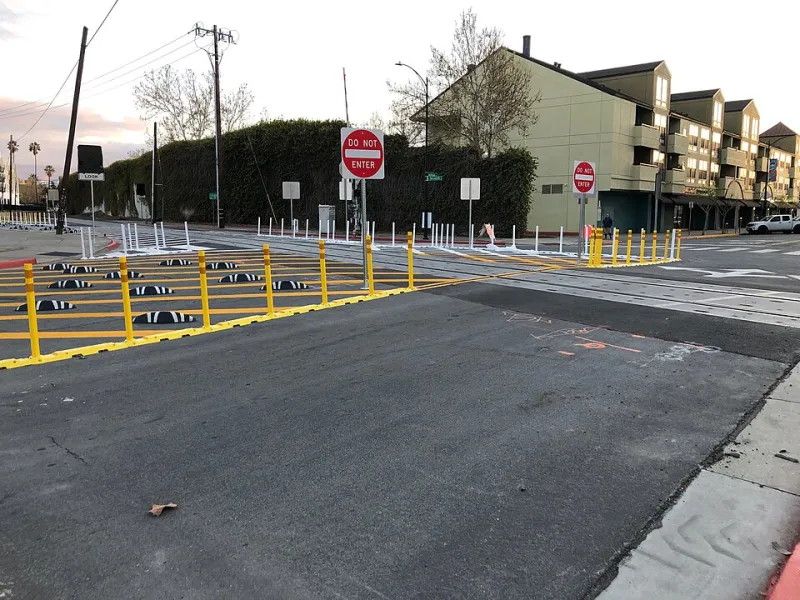
Photo: Minh Nguyen, CC BY-SA 4.0, via Wikimedia Commons
There's a specific sound a train horn makes when it's the last one you'll ever legally hear. In the little railroad towns scattered across the Great Plains and the suburban corridors of Illinois, that sound has been formally, bureaucratically retired. Welcome to the Quiet Zone — a federal designation, not a vibe — where a community can petition the government to make the trains pass in silence.
The Paperwork of Peace
Here's the part nobody tells you: a Quiet Zone isn't a noise ordinance. It's an FRA-approved safety trade. Under federal law, locomotive engineers are required to blast their horns at every public crossing — two longs, a short, a long, the saddest chord in America. To opt out, a town has to prove it has engineered the danger away instead: four-quadrant gates, medians, wayside horns aimed like stage lights. Silence, it turns out, is purchased with concrete and signal contracts.
I called a railroad attorney in Chicago — he asked to stay unnamed because, quote, "every one of these cases ends with somebody's cousin mad at somebody" — and he walked me through the logic. "The horn is a blanket safety measure," he said. "Quiet Zones let a municipality tailor it. But every decibel you remove, somebody's lawyer starts doing math."
The People Who Voted to Hear Less
In one Kansas town of about 4,000 people, the Quiet Zone passed with almost no opposition. The mayor told me the horn was "running the whole town's sleep schedule." Freight lines don't keep business hours. A 2 a.m. crossing blast doesn't care that you have a shift at the hospital in six hours.
But not everyone signed the hush. A retired conductor named Dale — he asked me not to use the town's name at all — sees it differently. "That horn was the town's heartbeat," he said, standing in his yard where the tracks are close enough to rattle the storm windows. "You take it out, and what's left? A town that's afraid of itself."
Dale's fear isn't abstract. Once a community formalizes its relationship with sound — once noise becomes something you can petition against — the door creaks open. There are already towns where the horn ban became a springboard: leaf blower restrictions in California suburbs, generator ordinances in the Southwest, a Michigan village that debated regulating church bells.
Slippery Slope or Sidewalk Repair?
The skeptics have a point worth taking seriously. Noise has always mapped onto class and race — highways through neighborhoods, compressors behind the cheap apartments. But the Quiet Zone movement raises the mirror question: who has the leisure, the legal budget, and the municipal bandwidth to file for federally certified silence? Quiet Zones cluster suspiciously in towns with the tax base to afford four-quadrant gates, which run into the hundreds of thousands of dollars per crossing.
Silence, in other words, is infrastructure. And infrastructure is never neutral.
Still, standing at a crossing in a Quiet Zone at dusk — no horn, just the rhythmic clatter and the gate lights blinking red into the dark — there's something uncanny about it. The train still comes. It just can't announce itself anymore. It feels less like peace and more like a secret the whole town agreed to keep.
Whether that's progress or erasure probably depends on which side of the tracks you sleep on. The tracks, notably, do not care. They just keep humming.