Nobody Sold You Serenity: On the Politics of Quiet
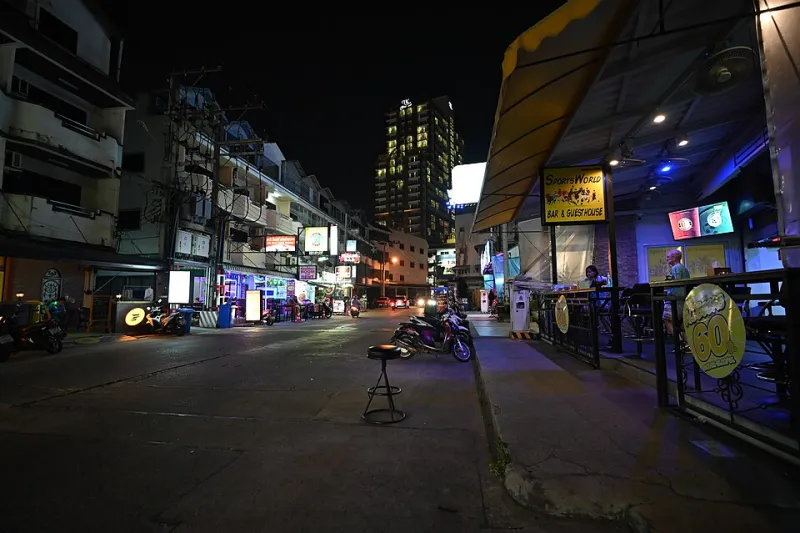
Photo: PattayaPatrol, CC BY-SA 4.0, via Wikimedia Commons
There's a candle on a shelf somewhere right now called "Stillness" that costs $68. There's an app charging a subscription for white noise. There's a cabin in Joshua Tree renting for $400 a night specifically because it has no Wi-Fi and, presumably, no neighbors. The wellness industry has discovered what real estate always knew: quiet is a product, and products have customers, and customers have incomes.
What the industry will never put on the label is this: silence was never neutral. Somebody made it, and somebody paid for it.
The Map Is the Argument
Pull up the noise maps for almost any major American city and you'll see the ghost of redlining staring back at you. Highways were routed through Black and brown neighborhoods. Compressors, freight yards, and airports were zoned where the political resistance was weakest. Decades later, the same neighborhoods are the loudest — and the same populations have the highest rates of noise-related hypertension, sleep disruption, and cognitive strain. Researchers have literally measured the health gap in decibels.
So when a wellness brand sells you silence as a personal achievement — a morning routine, a meditation cushion, a $349 pair of noise-canceling headphones — it's selling you an escape from a problem it has no interest in naming. Quiet becomes something you buy for yourself instead of something a society owes to everyone. That's not self-care. That's a subscription model for a public good.
Who Gets to Demand It
Watch how the discourse flows, too. When a wealthy enclave files noise complaints about concert venues, it's called quality of life. When a tenant in a loud building asks the landlord to fix the boiler at 3 a.m., it's called being difficult. When teens play music on a bus, we legislate against it; when a construction company starts at 6 a.m. next to an apartment building full of night-shift nurses, we call it commerce.
The demand for quiet is only as legitimate as the demander. That's not a natural law — it's a policy choice, repeated daily.
Quiet as Infrastructure
Here's the argument I'm actually making: treat silence the way we treat clean water. Not as a luxury you earn, but as a baseline you engineer. That means noise ordinances with teeth. Freight and flight paths that don't systematically burden the same zip codes. Building codes that treat soundproofing like insulation, not an upgrade. Public quiet — libraries, parks, actual funded quiet hours in shared housing — that isn't means-tested by your ability to buy a house with a yard.
The wellness industry's version of silence is a candle in a sealed room. Real quiet is a city where the nurses on the night shift can sleep, where the kid doing homework next to the freeway gets the same decibels as the kid in the suburbs.
Silence isn't the absence of noise. It's the presence of decisions. And until we admit that, every candle, app, and cabin is just a beautiful way of looking away.