Tuned to Nothing: The People Who Hear Broadcasts That Don't Exist
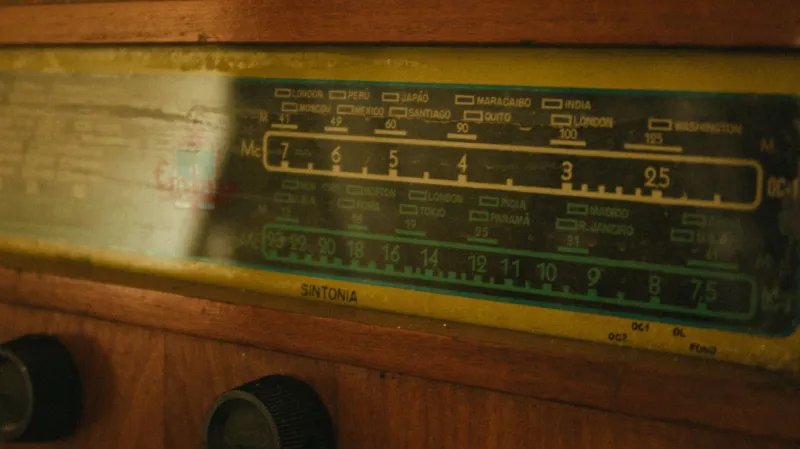
Diane lives in a suburb outside Tulsa, Oklahoma, and for the better part of three years, she believed her kitchen was haunted. Not by a ghost, exactly — more like a station. Every evening around dusk, she'd stand near the refrigerator and catch what she describes as a faint male voice, rhythmic and half-intelligible, like a talk radio host bleeding through a bad signal. She replaced the fridge. She had the wiring inspected. She eventually called a neurologist.
"He didn't laugh at me," she says, "but he had that look. Like he was already filing me somewhere."
Diane's experience sits at a strange crossroads — part auditory glitch, part urban legend, part genuinely documented phenomenon. And she's far from alone.
The Receiver Nobody Built
The idea that the human body can function as an unintended radio receiver sounds like something from a Cold War-era comic book. But the science, however niche, is real enough to have its own history.
The most famous version of the story involves dental fillings. In the mid-20th century, a cluster of reports emerged — some credible, some almost certainly embellished — from people claiming their metal dental work was picking up AM radio signals. The physics aren't entirely implausible: certain metal configurations can act as crude rectifiers, converting radio frequency signals into audio. The problem is the amplification. The human body is not, under normal circumstances, wired to boost a signal to audible levels. What's theoretically possible and what's practically happening are two very different frequencies.
Dr. Marcus Loy, a cognitive neuroscientist based in Boston who studies auditory processing anomalies, puts it plainly: "The filling thing is mostly myth, but it's a myth that keeps getting recycled because it almost makes sense. And almost-making-sense is catnip for the human brain."
Almost-making-sense is also, incidentally, the operating frequency of a lot of great art. But more on that later.
When the Brain Becomes the Broadcast Tower
What's more verifiable — and significantly stranger — is what happens when the brain itself starts generating phantom audio.
Auditory pareidolia is the perceptual tendency to find meaningful patterns in ambiguous sound. It's why you hear your name called in a crowded restaurant when no one said it, why white noise machines occasionally resolve into voices, why the hum of a highway can start to sound like music if you listen long enough. The brain is not a passive receiver. It's an aggressive pattern-matcher, constantly proposing interpretations of incoming data and occasionally inventing the data entirely.
Musical ear syndrome — sometimes called auditory Charles Bonnet syndrome — takes this further. People with hearing loss, in particular, sometimes begin experiencing vivid, involuntary auditory hallucinations: full songs, orchestras, voices delivering what sounds like programming. The brain, starved of input, starts generating its own content. It essentially becomes a pirate station, broadcasting to an audience of one.
"There's a certain cruelty to it," Dr. Loy notes. "You lose hearing and then you start hearing things that aren't there. But it also tells you something important about how much of what we perceive is constructed rather than received."
The Enthusiast Underground
Not everyone experiencing phantom frequencies is interested in a clinical explanation — or satisfied by one.
In online forums, Discord servers, and the occasional ham radio meetup, there exists a loose community of people who treat unexplained audio phenomena as something closer to a practice than a symptom. Some are amateur radio operators who've logged anomalous signals they can't account for. Some are self-described electromagnetic sensitives who believe they're physiologically tuned to frequencies most people filter out. Some are artists.
Ray, a sound designer in Portland who asked we use only his first name, has spent the last five years recording what he calls "infrastructure audio" — the ambient electromagnetic noise produced by power lines, transformers, and consumer electronics, converted into audible range via custom-built antennas. His work has been exhibited in gallery spaces and released on a cassette label out of Chicago that probably has twelve subscribers and deserves twelve thousand.
"I'm not claiming I hear things other people can't," he says. "I'm claiming that the signals are there and we've just agreed to ignore them. The gear just makes that agreement visible."
This is where the phantom frequency conversation gets genuinely interesting. The line between "I am receiving something real that others dismiss" and "I am creating meaning from noise" is not as clean as either the skeptics or the believers want it to be. Both things can be true simultaneously. Both things are, in a lot of ways, what artists do.
Folklore With a Half-Life
The cultural persistence of the radio-in-the-teeth myth — and its cousins, the haunted appliance, the signal in the wall, the broadcast only one person can hear — says something worth sitting with.
These stories tend to cluster around moments of technological transition. They spiked during the AM radio boom of the 1930s and 40s. They resurfaced during the CB radio craze of the 70s. They're showing up again now, mutated, in conversations about electromagnetic hypersensitivity and 5G anxiety. Each iteration reflects the same unease: the suspicion that the electromagnetic environment we've built around ourselves is doing something to us that we haven't consented to and can't fully measure.
That anxiety isn't irrational. It's also not the same as the specific claims being made. But folklore doesn't really care about that distinction. Folklore cares about the feeling.
"These stories are doing cultural work," says Dr. Priya Mehta, a folklorist at the University of Michigan who studies technology mythology. "They're a way of processing the fact that we live inside an invisible infrastructure that most of us don't understand and can't see. The phantom signal is a metaphor that got loose and started acting like a fact."
Static as Signal
Diane eventually got a diagnosis — a mild form of tinnitus complicated by stress-related hyperacusis, a condition that makes the auditory system hypersensitive to certain frequencies. The "voice" she was hearing was almost certainly her brain imposing structure on the mechanical hum of her refrigerator's compressor, a sound she'd tuned out for years until anxiety tuned it back in.
She's at peace with that explanation. Mostly.
"But I still think about what it felt like before I knew," she says. "Like something was trying to reach me. Like I was almost getting it."
That's the thing about phantom frequencies. The neuroscience is real, the physics are real, the folklore is real, and the feeling — that sense of almost-reception, of being on the edge of something being transmitted — is maybe the most real thing of all. It's the sensation that drives amateur radio operators to stay up until 3 AM chasing skip signals. It's what makes noise musicians treat static like a sacred text. It's what PPPHHHAAASSSEEE is, at some level, always trying to tune into.
The broadcast might not exist. The need to receive it absolutely does.