Eat the Frequency: Inside the Underground Dinner Clubs Rewiring Taste Into Color
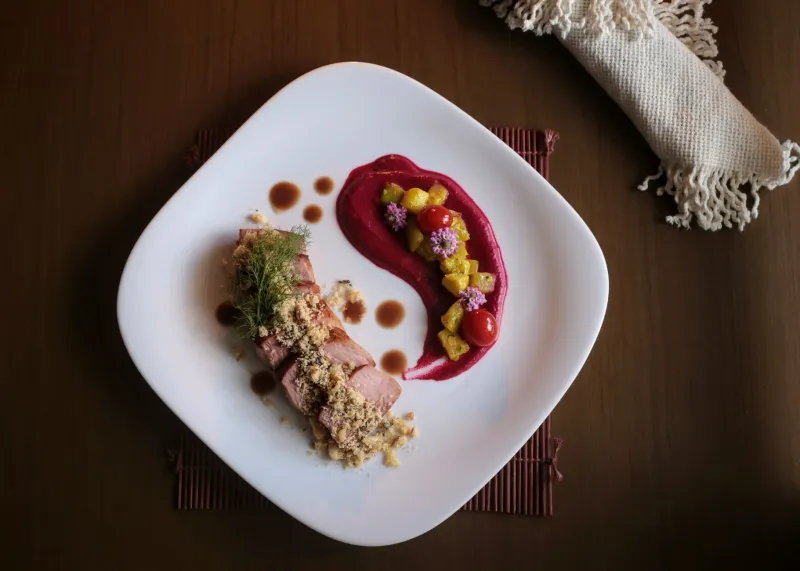
Somewhere in a converted warehouse in East Nashville, twelve strangers are sitting around a folding table, eyes closed, chewing a cube of something that looks like beet-cured tofu but tastes, allegedly, like the color orange. Not orange the fruit. Orange the hue. The organizer — who goes by Maren and declines to share her last name — passes a laminated card around the table. On it: a color wheel, a frequency spectrum, and a handwritten note that reads "Where do you land?"
This is a PHASE dinner. Not affiliated with us, for the record — but spiritually? Deeply, uncomfortably adjacent.
The Basic Premise Is Bananas (Sometimes Literally)
Synesthesia, for the uninitiated, is a neurological phenomenon where stimulation of one sense involuntarily triggers another. You hear a trumpet and see a smear of gold. You taste a strawberry and feel a sharp corner pressing into your palm. It's not metaphor. It's wiring — or more accurately, cross-wiring — and roughly four percent of the population has some form of it naturally.
The community Maren belongs to is not content with four percent. They want the other ninety-six to join the party, and they believe the fastest route there runs directly through the tongue.
"Taste is the most underrated sensory input we have," she says, clearing plates between courses. "It bypasses so much of our cognitive filtering. If you want to rewire perception, you start with what you eat."
The methodology — if you can call it that — draws loosely from neuroplasticity research, flavor pairing theory, and a not-insignificant amount of personal experimentation that would make most IRB committees sweat. Participants eat specific compound combinations in specific sequences, often under conditions designed to minimize competing input: low light, no music, phones face-down. The goal is to create what regulars call a "crossover event" — a moment where one sense bleeds into another in a way that feels unambiguous and repeatable.
DIY Taste-Mapping and the Flavor Frequency Chart
Maren's group isn't alone. Across cities like Portland, Brooklyn, Chicago, and Austin, small clusters of amateur sensory researchers are developing their own frameworks for what they call "taste-mapping" — a process of systematically cataloguing which flavor compounds produce which cross-sensory impressions in which individuals.
The tools are improvised but earnest. Shared Google Sheets with hundreds of entries. Discord servers where members post "session logs" describing their experiences in painstaking detail. One particularly obsessive spreadsheet, circulating in a private Telegram group, attempts to correlate specific flavor compounds — capsaicin, umami glutamates, certain terpenes — with reported visual frequencies, measured in nanometers of perceived color.
Is this science? Loosely. Is it art? Probably more so. Is it the most PPPHHHAAASSSEEE thing happening in American food culture right now? Absolutely yes.
The flavor frequency chart — a recurring artifact in these communities — maps taste sensations onto a spectrum that mirrors the visible light range. Bitter compounds cluster around the blues and violets. High-acidity foods trend yellow. Deep umami apparently reads as a low, slow red. Sweetness, counterintuitively, gets plotted near green by most practitioners, though this is a point of significant internal debate.
"The chart is a starting point, not a destination," explains one participant who posts under the handle @tongueprisma on a niche Discord server dedicated to sensory experimentation. "Your map is going to look different from mine. That's the point. We're building personal languages."
What the Neuroscientists Actually Think
Dr. Priya Mehta, a cognitive neuroscientist at the University of Michigan who studies multisensory integration, has been watching this trend with a mixture of genuine fascination and considerable concern. She's careful not to dismiss the underlying premise entirely.
"The science of neuroplasticity does support the idea that repeated, intentional sensory pairing can create new associative pathways," she says. "That part isn't fringe. What concerns me is the unregulated ingestion of compounds people don't fully understand, in pursuit of neurological changes they can't fully measure."
Some of the compounds showing up in these dinner club menus are benign — fermented foods, specific spice combinations, high-tannin ingredients. Others are murkier. There are reports of groups experimenting with microdosed psychoactive compounds alongside flavor sequences, which Mehta flags as a significant variable that could produce experiences participants misattribute to the food itself.
"You're potentially training your brain to associate certain flavors with certain perceptual states that were actually chemically induced," she says. "The long-term implications of that kind of conditioning in developing brains — we genuinely don't know."
The community, for its part, tends to respond to this concern with a shrug that isn't entirely dismissive but isn't particularly worried either. "People have been doing weird things with food and perception for thousands of years," says @tongueprisma. "We're just taking notes this time."
The Dinner as Performance, the Meal as Medium
What's easy to miss in the discourse around safety and pseudoscience is how genuinely artistic a lot of this work feels when you're actually in the room.
Maren's dinners are meticulously choreographed. Each course is designed to build on the last — a kind of sensory narrative arc that she describes as "composing with taste." The pacing matters. The silence matters. The moment when a room full of people simultaneously reaches for their color wheel cards and starts comparing notes has an energy that's hard to categorize but impossible to dismiss.
"I'm not trying to make people see things," she says. "I'm trying to make them notice that they're already seeing things. All the time. They just haven't been paying attention."
There's something almost liturgical about it — a communal practice built around the radical act of paying close, careful, collective attention to what your body is doing. In a culture that treats eating as a productivity problem to be optimized, gathering specifically to feel your food, to take it seriously as a perceptual event, reads as quietly subversive.
Frequencies You Can Swallow
The PPPHHHAAASSSEEE worldview has always been that reality is more porous than the default settings suggest — that with the right tools, the right attention, the right weird little community, you can start to hear the frequencies underneath everything. Usually we're talking about sound. Usually we're talking about music or static or the hum in the walls.
But maybe the tongue was always in on it.
Maren's next dinner has a waitlist. The color wheel cards are getting a second edition. Somewhere in a private spreadsheet, someone is logging their experience of tasting a sharp, fermented miso compound and perceiving, with genuine conviction, a band of deep ultraviolet at the edge of their visual field.
Is it real? Is it constructed? Is the distinction doing the work we think it is?
Chew on it.