Rust Belt Resonance: The Rogue Musicians Turning Dead Buildings Into Living Instruments
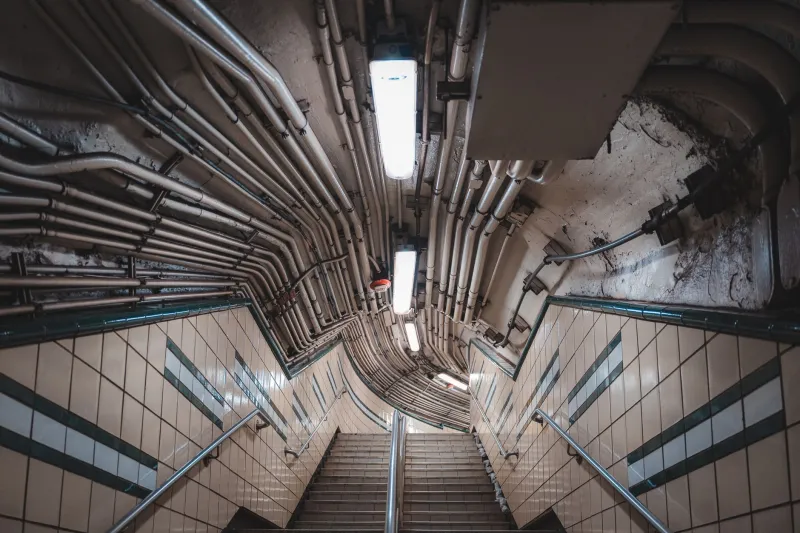
The building used to process insurance claims. Now it processes feedback.
Somewhere on the outskirts of Detroit, past a parking lot that nature has been quietly reclaiming for about a decade, there's a six-story concrete block with most of its windows boarded up and exactly one working freight elevator. On the fourth floor, a woman named Marisol—she goes by Copperwire in the forums—is crouched next to a decommissioned fire alarm panel, running alligator clips from its terminal screws into a battered Eurorack case. The building's original alarm system hasn't been active since 2011. Tonight, it's a sequencer.
"The pulse it throws is totally irregular," she says, not looking up. "Like, it's not on a grid. It's on its own time. That's the whole point."
This is what's happening in the margins of American experimental music right now, and it's weirder and more widespread than you'd expect.
The Infrastructure Is Already There. It's Just Waiting.
For a certain stripe of DIY producer, the most exciting synthesizer in the world isn't something you order from a boutique manufacturer in Portland. It's a building. Specifically, the kind of building that got left behind—a shuttered meatpacking plant in Chicago's Back of the Yards, a dead telephone exchange in Baltimore, a half-gutted textile mill somewhere in the Carolinas. These spaces are full of electrical systems, pneumatic networks, and analog signal infrastructure that nobody's using anymore. And for people like Copperwire, that's basically a free instrument.
The logic is simple even if the execution is not: old HVAC systems generate low-frequency hum when you push current through their ductwork in the right way. Defunct intercom networks still carry voltage through their wiring. Abandoned phone lines—particularly the older copper-pair systems—respond to audio signals injected at the junction box. None of this is what the engineers who designed these systems intended. But intention, in this scene, is kind of beside the point.
"Constraint is the whole engine here," says Marcus Fleiss, a Chicago-based producer who records under the name Halide. He's been doing this for about four years, mostly in industrial spaces on the city's far south side. "When you don't have money for gear, you start looking at what's already there. And what's already there is insane. Like, genuinely insane."
Scarcity as Aesthetic Philosophy
There's a lineage to this, obviously. Industrial music has been plundering factory floors since Throbbing Gristle. Noise artists have been abusing consumer electronics since before most of these musicians were born. But what's happening now feels different in a specific way: it's less about destruction and more about listening. These musicians aren't just making noise in abandoned buildings. They're treating the buildings themselves as instruments with their own tuning, their own resonant frequencies, their own quirks and personalities.
Copperwire talks about "learning a building" the way a jazz musician might talk about learning a room's acoustics before a gig. She'll spend her first few visits just walking the space with a contact microphone and a portable recorder, mapping where the structure vibrates, where the old wiring still carries ghost signals, where the HVAC ducts create standing waves at particular frequencies. Only then does she start patching anything in.
"Every building has a fundamental pitch," she explains. "Like, there's a frequency at which it wants to resonate. Once you find that, everything else is harmonics."
This approach has produced some genuinely startling music. Halide's last release—a 40-minute piece recorded entirely inside a former printing facility in Pullman—sounds like nothing so much as a building dreaming about what it used to do. There are rhythms in it that come from a pneumatic press that hasn't run in 15 years, coaxed back to partial life with a borrowed air compressor and a lot of careful rerouting. There are tones that come from the copper pipes in the basement, excited with a transducer and a signal generator. The whole thing breathes.
The Legal Gray Zone (Which Everyone Acknowledges and Nobody Dwells On)
Yeah, they're trespassing. This is not something anyone in this scene is particularly eager to discuss at length, but it's not something they're hiding either. Most of these buildings are in legal limbo—owned by holding companies or municipal land banks, not actively monitored, not currently slated for anything. The musicians aren't damaging anything. They're, in a weird way, the only people paying attention to these spaces at all.
"I think of it as temporary custodianship," says a Philadelphia-based artist named Tollgate who declined to give his real name. He's been recording in abandoned infrastructure across the Northeast for three years. "These places are just sitting there, rotting. Nobody cares. We go in, we make something, we leave it how we found it."
There's a kind of ethics that's developed around this practice, even if it's informal. Don't strip anything. Don't damage the structure. Don't tell too many people about a specific location. Share techniques freely but protect spots jealously. It's less a manifesto and more a set of manners.
What They're Actually Making
The music itself defies easy categorization, which feels right for a site called PPPHHHAAASSSEEE. Some of it is drone-based, long slow tones that accumulate over the course of an hour. Some of it is rhythmic in a broken, lurching way—the rhythm of systems that weren't designed to be rhythmic but are, because everything has a cycle if you look long enough. Some of it is almost melodic, accidentally, when the resonant frequencies of a particular duct or pipe happen to fall in harmonic relation to each other.
Halide describes the experience of playing a building as "like improvising with a collaborator who doesn't know they're a musician." The building responds to what you do, but not predictably. You send a signal into the phone line and something comes back that you didn't send. You excite a duct and the whole floor starts to hum at a frequency you weren't expecting. You lose control constantly. That's the feature, not the bug.
Copperwire is working on what she's calling a "building score"—a graphic notation system for documenting the sonic properties of a specific structure so that other musicians could theoretically perform it. "Like sheet music, but for a building," she says. "So the building is the instrument and the score is how you play it."
She hasn't finished it yet. The insurance building is still standing, for now. The fourth floor still smells like old carpet and something electrical. The alarm panel still has a pulse.
It's irregular. It's not on a grid. That's the whole point.