Sandpaper Sleeves and Melting Grooves: The Records Built to Die on the First Spin
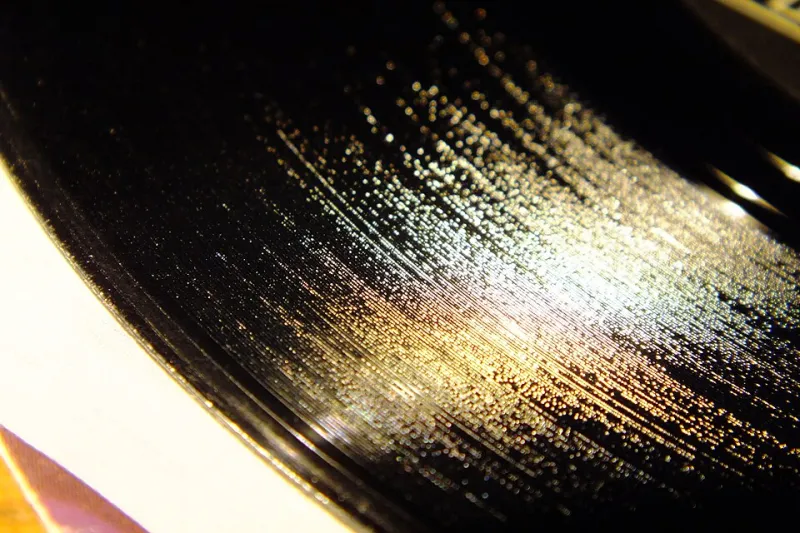
Photo: Altoscroll, CC BY-SA 3.0, via Wikimedia Commons
You drop the needle. There's a hiss, a low rumble, maybe a voice saying something you can't quite catch. Fifty seconds later the stylus skids and the room goes quiet, because the groove it was riding no longer exists. You didn't scratch the record. The record scratched itself.
This is not a defect. It's the product.
Over the past few years, a loose, mostly-unlabeled network of American pressing plants, noise artists, and small-run labels has been quietly manufacturing records that are engineered to fail — sometimes on the first play, sometimes on the fifth, always on purpose. The methods vary. The intent doesn't: make an object that can't be streamed, can't be ripped, can't be reloaded. You get one listen and a story.
How You Kill a Record On Purpose
The techniques are beautifully dumb once you hear them. The most common is the sandpaper sleeve — a standard paper inner sleeve with a sheet of fine-grit abrasive glued inside, so that every time the record slides in or out, it takes a little bit of itself with it. Play it twice and you've got surface noise. Play it ten times and you've got weather.
Then there's the lacquer problem. Proper acetates were never meant to be played more than a handful of times anyway; the coating is soft and the stylus is a chisel. A couple of small-run outfits have started leaning into that, pressing one-off acetates and shipping them with a note that says, in effect: this is not a durable good, this is an event. Some go further, cutting grooves so shallow that the second pass physically flattens the high end. You can hear the top of the mix die in real time, like watching a photo fade in a sunny window.
And then there are the aggressive ones. Records pressed with deliberate cross-grooves that kick the tonearm forward at a chosen moment. Records with a locked, self-erasing band that chews its own wall. Records whose final thirty seconds were cut so hot that the stylus starts carving instead of reading, so that each play permanently rewrites the ending. Every copy decays differently depending on your cartridge, your tracking force, your room temperature. It's a different album every time, and it's an album that is always getting worse.
The Anti-Streaming Argument Nobody Asked For
The people making these things are not subtle about why. Ask a label owner and you'll get roughly the same speech: streaming made music infinite and therefore weightless. Every song you've ever loved is available, forever, in identical condition, at zero marginal cost, and that is a kind of death. Rarity had to be reintroduced by hand.
You can roll your eyes at that. Plenty of people do. But there's a real structural argument buried in the gimmick. A record that disintegrates inverts the entire economics of recorded sound. It has no resale value at the top end — or rather, its resale value is weirdly inverted, because an unplayed copy is the rare one. What you're buying isn't the music. The music is available. What you're buying is an appointment with the music, one that you can miss.
There's also the ritual side of it, which is the part that actually lands with people who own turntables. Vinyl's whole comeback has been sold as a slow-down — you have to flip it, clean it, put it away. Self-destructing records take that logic to its endpoint. The slow-down becomes a countdown.
What Collectors Are Actually Paying For
Prices are not gentle. Single-press runs in the low hundreds routinely go for $60 to $120 at the drop. The sandpaper-sleeve editions — which come with a printed warning and a little brush, bless them — sit at the top of that range. One-off acetates with hand-drawn labels have been trading in the low three figures on the secondary market, and yes, there is a secondary market, because people buy records they're afraid to play.
That fear is the whole point, and it's also the funniest part of the scene. A community has formed around the exact thing the format was built to prevent: keeping a copy pristine. There are people with self-destroying records filed away in climate-controlled shelves who have never once put them on a platter, treating a piece of anti-collectible art as a collectible. The artists find this hilarious. Some of them find it infuriating. A few have started numbering copies and publicly shaming the ones that turn up unplayed, which is the most avant-garde use of a spreadsheet I've seen this year.
The Object That Won't Survive the Party
Here's what I keep coming back to. These records are social objects disguised as solo objects. You don't put one on alone in a dark room and have a nice time. You put one on with four people in the room, and everyone leans in, and someone says don't touch the table, and then it's over and everybody looks at each other like something happened.
That's a live show. That's a live show you can hold in your hand and that will never exist again, not even if you buy a second copy, because your copy is going to die differently than mine.
Is it precious? God, yes. Is it a little silly? Absolutely. But in a year where every band on earth is selling you the same remastered deluxe edition forever, there's something genuinely appealing about an object with a lifespan measured in plays. Buy it. Play it. Lose it. That's the deal, and the deal is the art.